Project Overview
This speculative project demonstrates my ability to plan and deliver a digital communications campaign for a wildlife conservation charity.
Wild Neighbours UK is a fictional organisation that encourages people to connect with local wildlife through citizen science, education and community engagement.
The campaign promotes Wild Neighbours Week, a seven-day initiative encouraging people across the UK to observe, photograph and record the mammals living in their local parks, gardens and neighbourhoods.
The project demonstrates campaign planning, copywriting, social media content creation, website writing, audience engagement and campaign evaluation.
Campaign Objectives
• Increase awareness of UK mammals.
• Encourage participation in wildlife recording.
• Inspire younger audiences to connect with nature.
• Grow the charity's online community.
• Increase newsletter sign-ups.
• Generate user-created content during Wild Neighbours Week.
Target Audience
Primary audience
• Adults aged 18–45
• Families
• Students
• Wildlife enthusiasts
Secondary audience
• Schools
• Community groups
• Young people active on Instagram and TikTok
• First-time participants in citizen science
Key Message
Nature is closer than you think.
Every garden, park and woodland is home to remarkable mammals. By taking part in Wild Neighbours Week, everyone can contribute to conservation while discovering the wildlife living on their doorstep.
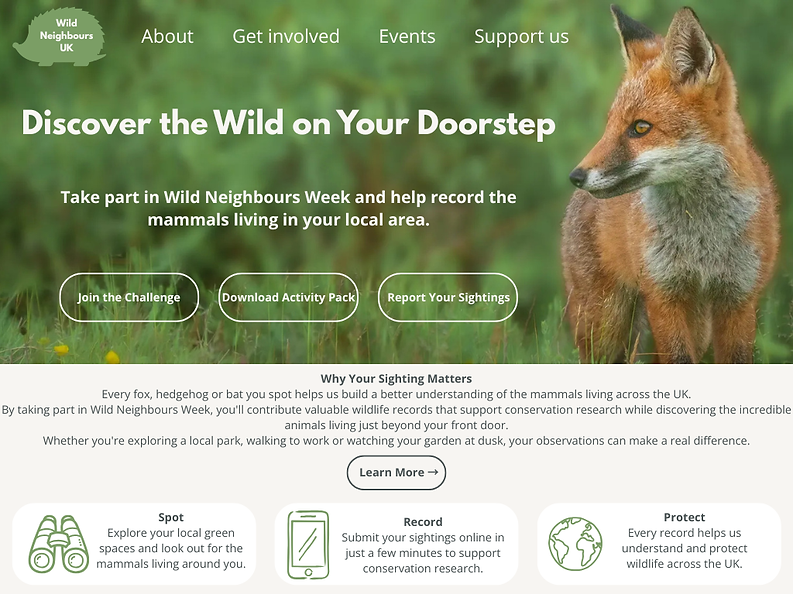
Website Landing Page
Communications Campaign – Wildlife Conservation Charity – Wild Neighbours Week
Instagram Campaign
(one post for each day of 'Wild Neighbours Week')

Hedgehogs are one of Britain's most loved mammals, but their numbers have declined in recent decades due to habitat loss and barriers that make it harder for them to move between gardens.
You can help by leaving a small gap in your fence, providing water during dry weather and avoiding the use of slug pellets.
🌿 Every wildlife sighting helps us learn more about the mammals living across the UK. Share your discoveries using #WildNeighboursWeek and help us build a picture of wildlife on our doorsteps.

Foxes are one of the UK's most adaptable mammals. They can thrive in woodlands, farmland and even our towns and cities, often becoming active at dusk when it's quieter.
Have you spotted a fox in your neighbourhood recently?
🌿 Every wildlife sighting helps us learn more about the mammals living across the UK. Share your discoveries using #WildNeighboursWeek and help us build a picture of wildlife on our doorsteps.

Bats play an important role in keeping insect populations under control and are often seen flying at dusk around gardens, parks and ponds.
If you head outside on a warm evening, look up—you might spot one darting through the sky!
When was the last time you saw a bat?
🌿 Every wildlife sighting helps us learn more about the mammals living across the UK. Share your discoveries using #WildNeighboursWeek and help us build a picture of wildlife on our doorsteps.

Badgers are one of Britain's largest land mammals and spend much of the day underground before emerging after sunset to forage for food.
Have you ever spotted badger tracks or a sett on one of your walks?
🌿 Every wildlife sighting helps us learn more about the mammals living across the UK. Share your discoveries using #WildNeighboursWeek and help us build a picture of wildlife on our doorsteps.

Whether you love seeing them in local parks or your own garden, grey squirrels play an unexpected role in woodland regeneration by accidentally planting future forests.
Have you ever watched a squirrel bury its food?
🌿 Every wildlife sighting helps us learn more about the mammals living across the UK. Share your discoveries using #WildNeighboursWeek and help us build a picture of wildlife on our doorsteps.

Often mistaken for rats, water voles have blunt noses, furry tails and a love of slow-moving rivers, streams and canals.Protecting healthy wetlands gives water voles a better chance of survival.
Have you ever seen one in the wild?
🌿 Every wildlife sighting helps us learn more about the mammals living across the UK. Share your discoveries using #WildNeighboursWeek and help us build a picture of wildlife on our doorsteps.

Once rare across much of the UK, the European otter is making an encouraging comeback thanks to cleaner rivers and habitat conservation.
Although they're shy and difficult to spot, signs such as footprints (called spraints), slides on muddy riverbanks and fish remains can reveal they're nearby.
If you're lucky enough to spot an otter, admire it from a distance and avoid disturbing its natural behaviour.
🌿 Every wildlife sighting helps us learn more about the mammals living across the UK. Share your discoveries using #WildNeighboursWeek and help us build a picture of wildlife on our doorsteps.
Instagram Carousel Format


Instagram Stories


TikTok Campaign Ideas
-
"Three mammals you've probably walked past today"
-
"Guess the animal from the footprint"
-
"Myth vs Fact"
-
"Spend one minute spotting wildlife with me"
Email Newsletter

Wildlife Spotting Guide (PDF)

Analytics Dashboard
-
Instagram Reach: 18,400
-
Followers gained: 320
-
Story interactions: 1,100
-
Newsletter sign-ups: 140
-
Wildlife records submitted: 650